

Single-atom engineering prevents voltage decay in next-generation lithium-ion batteries
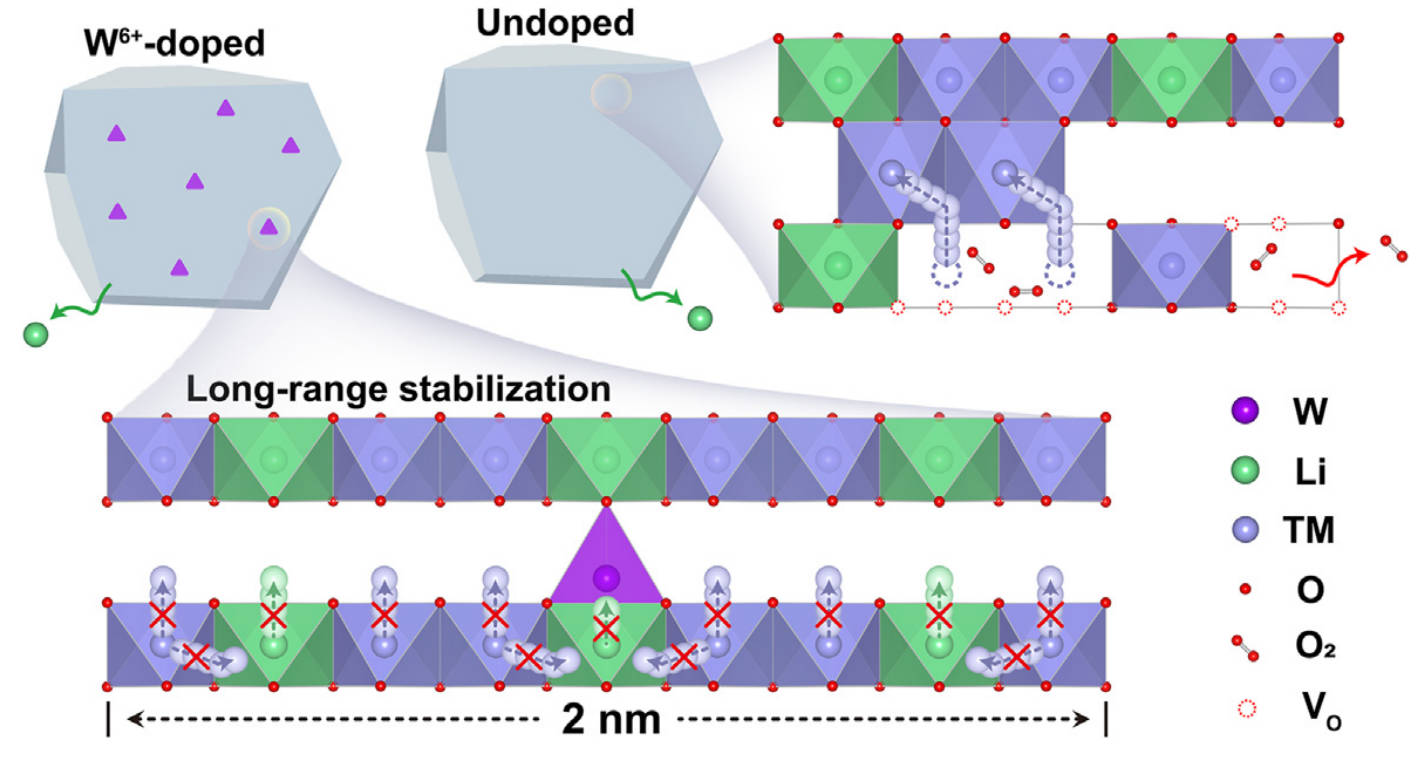
Tetrahedral-site W⁶⁺ dopants enable long-range structural stabilization in li-rich cathodes.
GA, UNITED STATES, December 22, 2025 /EINPresswire.com/ -- Lithium-rich layered oxides (LRLOs) offer exceptionally high capacities but suffer rapid energy loss because of irreversible migration of transition-metal (TM) ions during cycling, triggering oxygen release and voltage decay. This study presents a breakthrough strategy: using trace dopants (only 0.75 at.% W⁶⁺) placed precisely at tetrahedral sites in the lithium layer. These isolated single dopants exert long-range Coulomb repulsion, suppressing both in-plane and out-of-plane TM migration across a ~2-nm region. As a result, cation ordering is preserved over 250 cycles, oxygen release is significantly reduced, and voltage decay drops to just 0.75 mV per cycle. This work provides a new atom-efficient pathway for stabilizing high-energy LRLO cathodes.
Conventional Li-ion cathodes rely on cation redox and offer limited capacity, prompting global efforts to develop LRLOs materials that harness anion redox for higher energy density. Yet the commercialization of LRLOs is plagued by TM migration, oxygen dimer formation, and structural collapse, which accelerate voltage fade during charging to high voltages. Existing mitigation strategies—surface coating, octahedral-site doping, or compositional tuning—typically maintain cation ordering for fewer than 50 cycles. Doping at tetrahedral interstices is promising to prevent out-of-plane TM migration, but direct experimental evidence for effective tetrahedral-site doping has been lacking. Therefore, there is a pressing need to conduct in-depth research on trace dopants that can stabilize LRLOs at the atomic scale.
Researchers from Nankai University reported (DOI: 10.1016/j.esci.2025.100406) on November 2025 in eScience a new atomic-scale stabilization mechanism for lithium-rich layered cathodes. Using aberration-corrected transmission electron microscopy, X-ray diffraction (XRD), electron energy-loss spectroscopy (EELS), and first-principles calculations, the team demonstrated that sub-1 at. % tungsten dopants can occupy tetrahedral sites in Li₁.₂Mn₀.₆Ni₀.₂O₂, suppressing both in-plane and out-of-plane cation migration that has long hindered LRLO commercialization. The study reveals how a single dopant can influence a broad region (~2 nm diameter) and significantly extend structural stability for over 250 cycles.
The team synthesized W⁶⁺-doped LRLOs and directly visualized the dopant location using atomic-resolution high-angle annular dark-field (HAADF) imaging, confirming that W⁶⁺ occupies tetrahedral interstices rather than conventional octahedral sites. This unique site occupancy is stabilized by the flexibility of surrounding LiO₆ polyhedra, which absorb strain caused by electrostatic repulsion. Crucially, each W⁶⁺ dopant influences a ~2-nm diameter region, far exceeding the local stabilization range typical of octahedral-site dopants.
Both HAADF imaging and ex situXRD measurements show that the characteristic honeycomb superstructure disappears in the undoped cathode after 20 cycles but remains visible after 250 cycles in the W-doped sample. In situ XRD demonstrates that lattice strain during high-voltage charging is dramatically reduced, owing to suppressed TM migration. EELS measurements confirm that oxygen vacancy formation, detrimental phase transition, and O₂ release—hallmarks of LRLO degradation—are strongly inhibited after 100 cycles.
Electrochemical testing shows that the optimal 0.75 at.% W⁶⁺ composition offers the best balance of capacity, voltage retention, and long-term stability, with only 0.150 V of voltage decline after 200 cycles.
The key finding is that a single W⁶⁺ dopant at tetrahedral sits can generate long-range Coulomb repulsion that simultaneously blocks both in-plane and out-of-plane TM migration, which prevents the cascade of structural degradation typical of LRLOs. Unlike previous strategies relying on octahedral-site doping or surface treatments, this approach maximizes atom efficiency and preserves bulk ordering using only trace dopants. The researchers emphasize that this mechanism challenges long-held assumptions about doping effects and provides a unifying explanation for behavior previously observed but poorly understood in doped LRLO systems.
This work establishes a new design philosophy for next-generation lithium-ion batteries: stabilizing high-energy cathodes through tetrahedral-site dopant engineering. Because LRLOs suffer from voltage fade primarily due to bulk structural degradation, the demonstrated ability of trace W⁶⁺ ions to maintain ordering over hundreds of cycles marks an important step toward commercial viability. The findings also suggest that other high-valence dopants may be similarly effective, opening avenues for designing durable cathodes across multiple layered oxide systems. With improved voltage retention, reduced oxygen loss, and high structural integrity, tetrahedral-site doping may enable practical high-energy, long-life batteries for electric vehicles and grid storage.
DOI
10.1016/j.esci.2025.100406
Original Source URL
https://doi.org/10.1016/j.esci.2025.100406
Funding information
This work was supported by the National Natural Science Foundation of China (22393902, 22121005, 92372001 and 22393900).
Lucy Wang
BioDesign Research
email us here
Legal Disclaimer:
EIN Presswire provides this news content "as is" without warranty of any kind. We do not accept any responsibility or liability for the accuracy, content, images, videos, licenses, completeness, legality, or reliability of the information contained in this article. If you have any complaints or copyright issues related to this article, kindly contact the author above.
